General Randall Reed Visits Campus
USTRANSCOM Commander seeks to champion both military and commercial maritime transportation in Washington
By Michael Dickerson, Ph.D.
WITH SNOW BLANKETING the ground beneath a cloudless blue sky and temperatures in the single digits, General Randall Reed, commander of United States Transportation Command (USTRANSCOM), arrived at the Maine Maritime Academy campus at 0745 on February 9. It marked the first visit by a four-star general in living memory.
USTRANSCOM is a “combatant command which provides support to the ten other U.S. combatant commands, the military services, defense agencies, and other government organizations.” The command coordinates global logistics for the Department of Defense using both military, including the Military Sealift Command, and commercial resources.
In United States Senate Armed Services Committee testimony on March 12, General Reed highlighted the importance of the commercial shipping industry to USTRANSCOM’s strategic sealift capability during crises. According to General Reed, USTRANSCOM “delivers the mass of our combat power through the decisive strength of sealift sustainment.” The commercial fleet, the General estimates, provides “more than 90% of sustainment [transporting materiel] to deliver power and presence at the time and place of our choosing.”
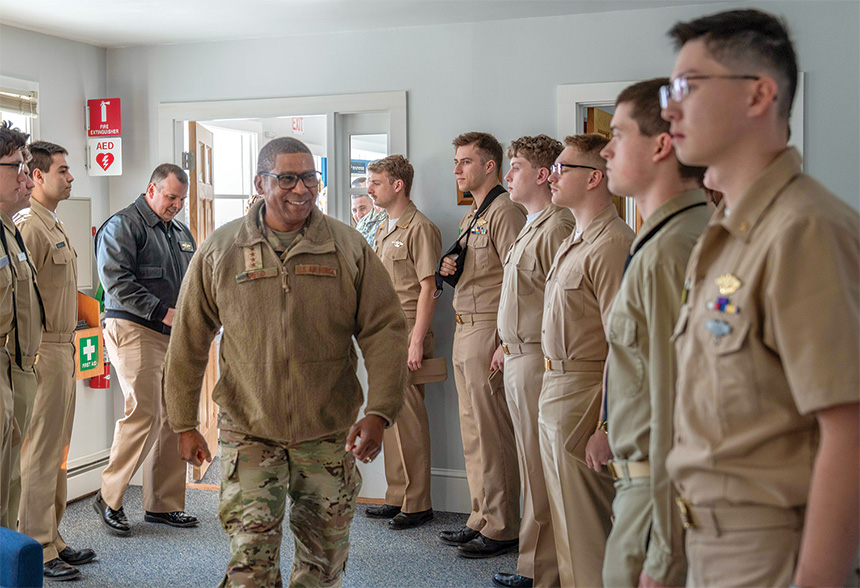
General Reed visits the NROTC building.
During testimony, General Reed indicated that in conflict “competitors train to turn logistics into a primary battlespace” and emphasized that the “priority remains keeping power projection as the Joint Forces’ decisive strategic advantage.” Senator Mark Kelly agreed, adding that the federal government “need[s] to do more to support the commercial industry we rely on.”
“Competitors train to turn logistics in a primary battlespace and the priority remains keeping power projection as the Joint Forces’ decisive strategic advantage.”
— General Randall Reed
Commandant of Midshipmen Captain Justin Cooper welcomed the General and his delegation to campus upon their arrival. The group, visiting from Scott Airforce Base outside Belleville, Illinois, entered Leavitt Hall through two rows of saluting cadets as the blue four-star flag was raised behind them.
The USTRANSCOM delegation met with President Johnson and senior representatives from the office of Senator Susan Collins. Affable and engaging, General Reed made a point of introducing himself to students, staff, faculty, parents, and political delegates alike, enthusiastically asking how he might help tell their stories in Washington.
Those in attendance emphasized the importance of collaboration with the federal government to ensure the Academy can continue to efficiently supply a strong pipeline of mariners to both the military and private sector, an objective recognized as a strategic national priority.
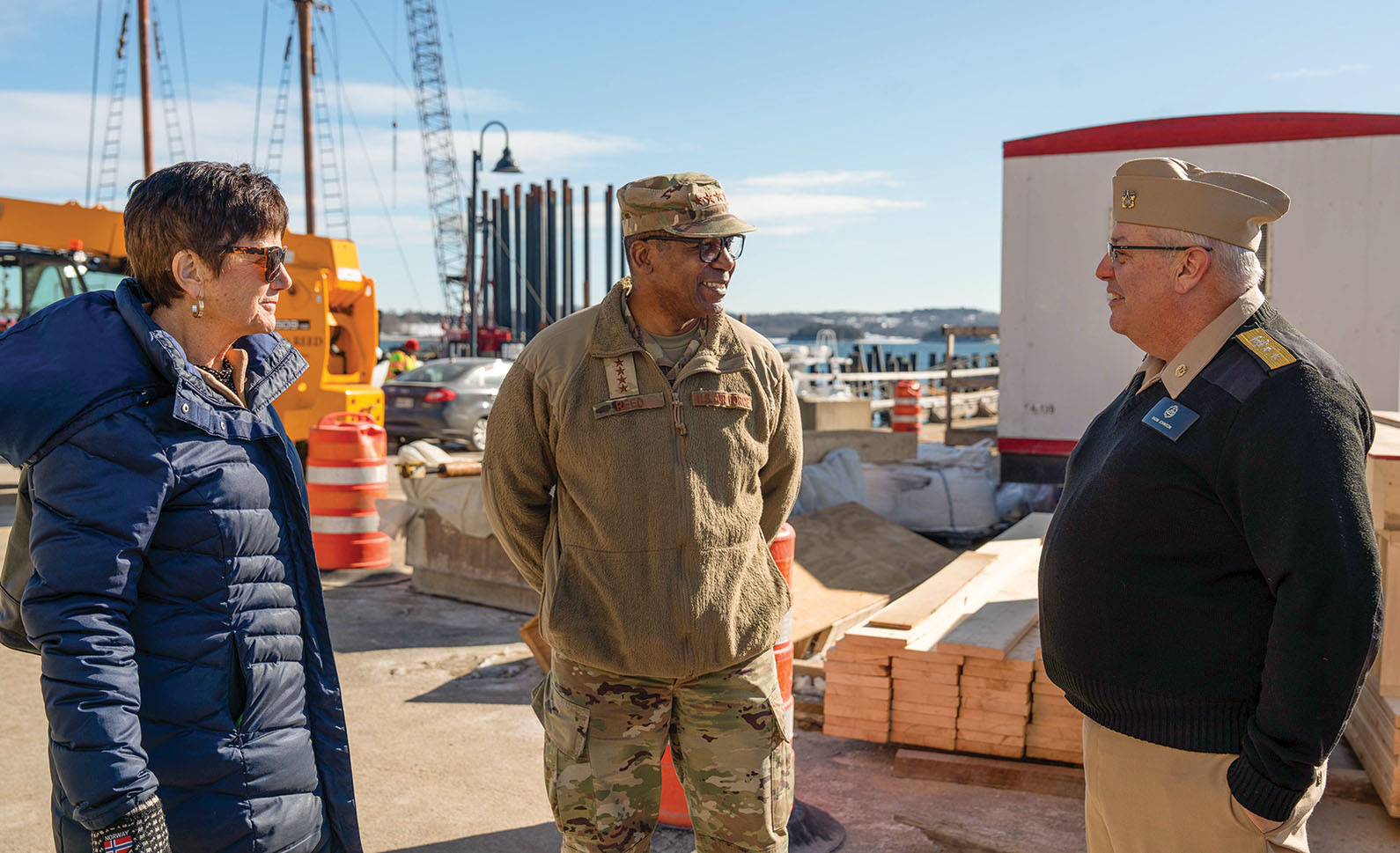
General Reed visits the waterfront improvement project with President Johnson and Carol Woodcock from the office of Senator Susan Collins.
The discussion continued in a larger meeting chaired by President Johnson in the Holmes Heritage Room. On multiple occasions, General Reed asked about the Academy’s ability to quickly increase training capacity during times of conflict, “What would a surge look like… and what would you need?”
President Johnson affirmed the Academy’s ability to respond to a sudden increase in demand for mariners, noting that the new training vessel will be a “gamechanger” for instructional capabilities and highlighting the potential to expand capacity at the Brunswick facility for workforce development. While Identifying opportunities for growth, he also underscored tuition costs as a critical barrier to training more mariners.
General Reed acknowledged the impressive outcomes achieved by the Academy and asked about the “secret sauce… What’s your magic?”
Trustee Bill Eisenhart, former Cal Maritime Academy president, emphasized the strength of the campus community and the close relationships formed there. “What makes this place special is the people,” President Johnson echoed, “We care about each other here.” Regimental Commander Odegaard Fields ’26 added that the Academy cultivates not only great leaders, but exceptional citizens.
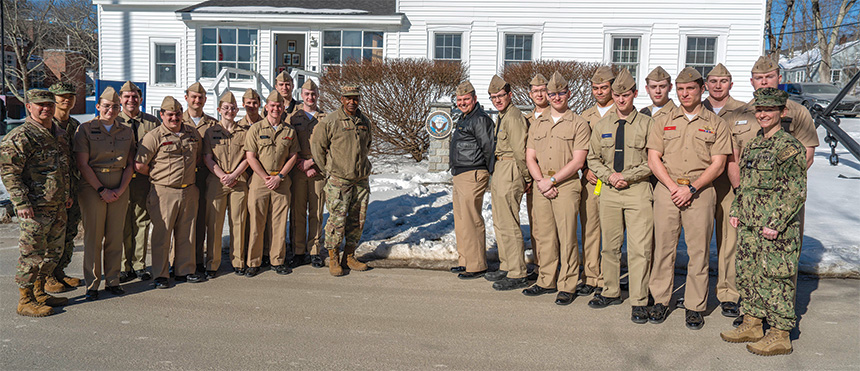
General Reed meets with NROTC Commanding Officer Captain Gary Chase and NROTC midshipmen.
General Reed acknowledged a key challenge in maritime recruiting: while many individuals express a desire to serve, awareness of maritime career pathways remains limited. Commandant
Cooper suggested that USTRANSCOM consider leveraging the STATE OF MAINE and other National Security Multi-Mission Vessels to raise the visibility of State Maritime Academies and the career opportunities they offer.
Marine Transportation Chair Ender Asyali, Ph.D. noted that the Academy’s hands-on, experiential learning model is both a strength and challenge. Cutting edge training tools, including advanced simulators, enable world-class instruction but require substantial, sustained financial investment to remain state-of-the-art.
Engineering Chair Don McCann raised concerns with General Reed regarding recent modifications to the U.S. Coast Guard licensing examination. He argued that flawed testing procedures prevent otherwise qualified candidates from earning their credentials.
When General Reed asked cadets why they chose to attend Maine Maritime Academy, many cited a call to public service both to the state and country.
Before leaving, General Reed described the specialized nature of USTRANSCOM’s mission, emphasizing its role in “championing all aspects of transportation, not just military.” He underscored the strategic importance of maritime professionals and the urgency of investing in the next generation, stating, “Our time is now… how can I help?”





Post Comment
Comments are moderated and will be reviewed prior to posting online. Please be aware that when you submit a comment, you agree to the following rules:
Maine Maritime Academy reserves the right to delete any comment that does not comply with these guidelines and is not responsible or liable in any way for comments posted by its users. If you have a message for the editor, please email mariner@mma.edu.
At the Academy
View All >Read More
Read More
Read More