F/V Entropy: An Ambitious Capstone Project
By Michael Dickerson, Ph.D. with Alden Sawyer
AMONG THE OPPORTUNITIES that differentiate Maine Maritime Academy from other institutions are the hands-on, experiential learning and the access to the Academy’s waterfront campus. This semester, a group of students took what they learned over several years at the Academy, leveraged waterfront resources, and garnered support from sponsors to undertake one of the more ambitious capstone projects in recent memory.
The project is being led by Alden Sawyer, a five-year Marine Systems Engineering student expecting to graduate in December. He is joined by classmates Devin Grant, Rory Carlson, and Griffin Stolp, all of whom are in the same program.
The team completely stripped and gutted the 1979 Holland 30’ boat and replaced and rebuilt everything including a new engine, new engine hangers, engine beds, hydraulics, electrical wiring, fuel exhaust stack to a 6-inch underdeck wet exhaust, went from 1.5-inch to 2-inch propeller shaft, replaced the fiberglass rudder with a custom stainless steel rudder, upgraded the reduction gear, and did a complete refit of hydraulic system.
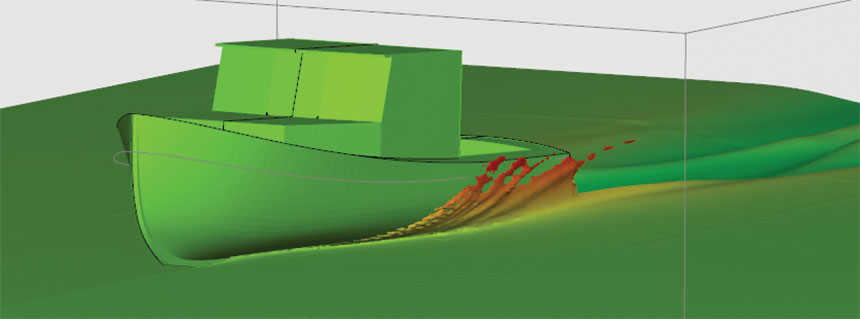
CAD Model
The team took the lines of the boat and made a 3D CAD model in Rhino, which they uploaded to ORCA3D, a marine design and analysis software. The analysis helped the team determine theoretical hydrostatic properties of the boat at various speeds and displacements such as heave, pitch, and hull resistance. With the goal of maximizing speed, the most important of the results was the speed power curve the software produces.
“CAD told us what was possible and what we needed to do to make it possible,” Sawyer said. “We spent countless hours doing computational fluid dynamics (CFD) runs that took days for a single file or modifications to the hull.” Sawyer contacted various boat builders including Matt Sledge of Samoset Boatworks and Glen Holland of Holland’s Boat Shop to compare computational fluid dynamics (CFD) data to real experimental data to make sure they were on the right track.
Professor of Engineering Douglas Read is the faculty advisor for the project. “This project was ambitious to say the least,” Read said. “But by doing both the engineering analysis and the actual modifications, they were able to connect the more abstract calculations to the behavior of the actual boat. Hydrostatic properties, weight, and trim mean a lot more when you’re trying to figure out how your boat will float on launch day.
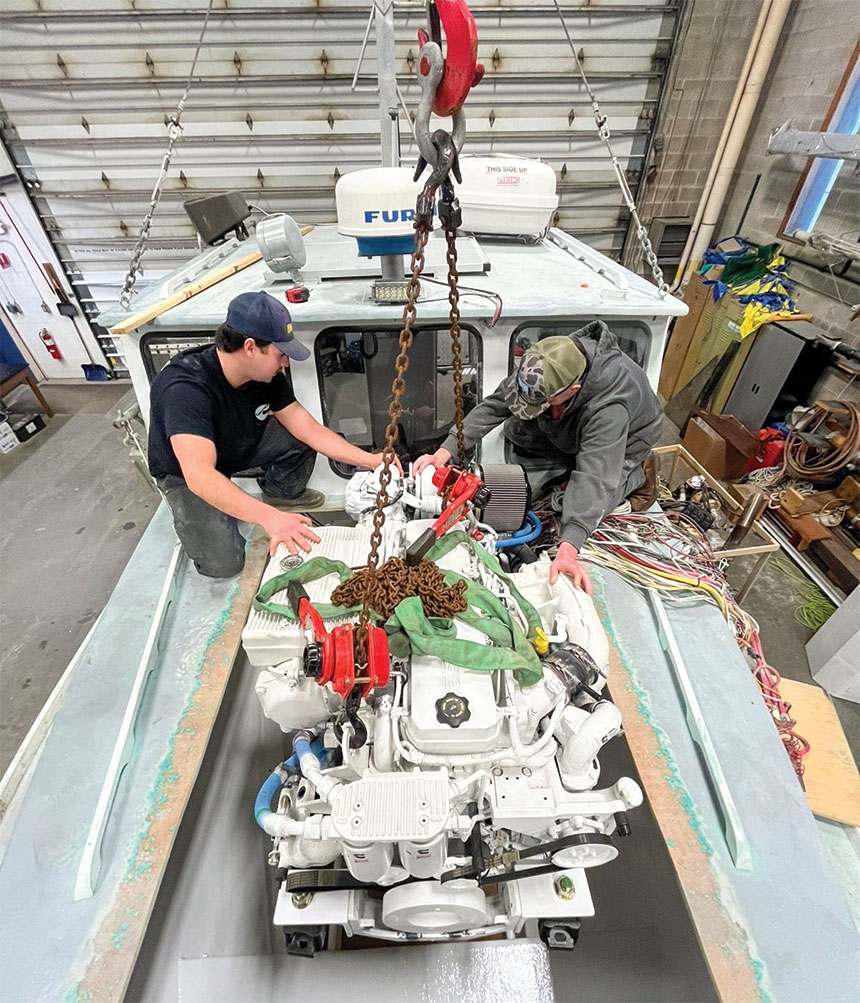
Working on the engine.
To fund the project, Sawyer solicited sponsors and secured support from Maine Maritime Academy, the MMA welding and machine shop, Samoset Boatworks, Freeport Diesel & Marine, Billings Diesel & Marine, Hamilton Marine, R.E. Thomas Marine Hardware Inc., Lonnies Hydraulics, Marine Hardware, Nautilus Marine Fabrication and Propellor Service, Downeast Yacht Services, and Eaton’s Boatyard.
“This project is another example of how MMA supports experiential learning,” said Waterfront Director Dana Willis. “The student group negotiated needs for shop time and equipment from the Waterfront and learned why scheduling is important. They’ve done a great job with the repower, and I’m eager to see the finished project in the water.”
“Having Alden and the other students working on the Lobster boat repower project has been a great inspiration” said sailing master Will McLean ’12. “Watching Alden and his team working to solve problems and figure out all the details it takes to repower a boat has been great. There is not another school around that gives students this type of opportunity for hands-on problem solving, so it’s fun to see the excitement the students have for the knowledge that they are gaining.”
Being systems engineers, the team found the new name “Entropy” fitting, as it had been a of their engineering curriculum and is defined as a measure of disorder, randomness, or how spread-out energy is within a closed system.
“I am so grateful to be at a school where I can take what I have learned over my time here and really apply it to something I am so passionate about. I have learned how to organize a team of people to make a project like this happen and learned how to reach out and make connections with people and companies. This project has taught me so much more than I could have imagined and made me much more confident as a mariner”
Alden and his classmates plan to race the boat this summer in the Maine 2026 Lobster Boat Race Series starting with the first race in Boothbay on June 20th. Follow along with the build @fv.entropy on Instagram.




Post Comment
Comments are moderated and will be reviewed prior to posting online. Please be aware that when you submit a comment, you agree to the following rules:
Maine Maritime Academy reserves the right to delete any comment that does not comply with these guidelines and is not responsible or liable in any way for comments posted by its users. If you have a message for the editor, please email mariner@mma.edu.
At the Academy
View All >Read More
Read More
Read More